Does anyone know if it's possible to create a single report that pulls data from multiple companies. I'm looking to get a data dump from a specific table that reside in each specific company. Any ideas?
Date
Votes
3 comments
-

Jet Reports Historic Posts Hello -
Assuming that you are using NAV, you would want to use the "COMPANY=" filter (http://kb.jetreports.com/article/AA-00491 - scroll about half-way down) -
Jet Reports Historic Posts Yes, I'm using it for Navision. Here is an example of what I would like in one report. Is there a function or a way I can write the function to include these 2 companies to populate data to run on one report. I don't want to have multiple worksheets for each company.
=NL("rows","Customer","Customer No.","Company=","Company 1","DataSource=","MyDataSource")
=NL("rows","Customer","Customer No.","Company=","Company 2","DataSource=","MyDataSource") -
Jet Reports Historic Posts It is possible to a certain extent. However, you could run into issues. Let me illustrate.
Let's suppose I have COMPANY1 with the following customers:
Cust # - Name
————- ———-
10000 - ABC Corp
20000 - XYZ Company
30000 - MyComp
And I have COMPANY2 with the following customers:
Cust # - Name
————- ———-
30000 - Timely Watches
40000 - Super Market
50000 - Last but not Leased
I can certainly create two NL() functions list this:
=NL("rows","Customer","Customer No.","Company=","Company 1","DataSource=","MyDataSource")
=NL("rows","Customer","Customer No.","Company=","Company 2","DataSource=","MyDataSource")
to create:
10000
20000
30000
30000
40000
50000
This works great and would be the recommended way of listing out multiple sets of similar data.
Yes, I could (technically) combine both lists into a single NL(Rows) function by using to NL(Filters) {one for each company} and then using the NP(Union) function within my NL(Rows) to combine them.
However, assuming that I wanted to do something with those customer numbers (e.g., report the customer name), I'd be stuck - I wouldn't know which company to look at to get it (especially for customer #30000… which customer is that?). I would have to take into account that either company could (potentially) have pertinent data for any particular customer number.
e.g.,
or
resulting in something like this: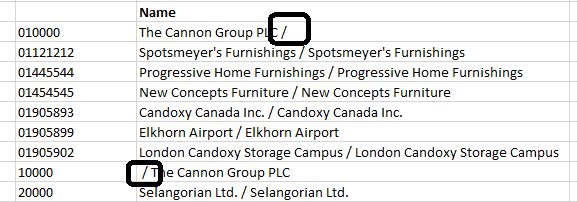
Please sign in to leave a comment.